Thursday, February 18, 2010

Gatchaman--Opinion


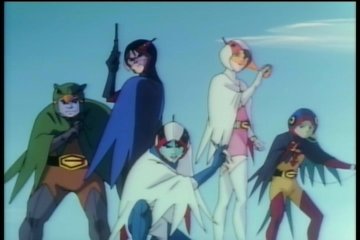
Sosai X, Berg Katse, and their organization known as Galactor are bent on dominating the world. Fortunately, Dr. Nambu and the Science Ninja Team Gatchaman have something to say about it.

Gatchaman is a brainchild of Tatsuo Yoshida, who is probably more well-known for Macha Go Go (known in the States as Speed Racer). Like its Tatsunoko predecessor, Gatchaman was known by other titles, and was dubbed no less than THREE times into English. The first was Battle of the Planets; while the dub acting itself was decent and the original music is preserved, the story was more or less butchered beyond recognition in order to bear a resemblance to Star Wars. In fact, for BotP, the more violent scenes were edited out and new Hanna-Barbera animation were put in, usually of stock spaceflight footage and of 7-Zark-7, a robot that was pretty clearly an amalgamation of C-3PO and R2-D2 from Star Wars.

I was first introduced to Gatchaman in its second dub, G-Force: Guardians of Space. Relatively speaking, the story was closer to the Japanese version, though the names are still changed. However, the voice-acting was pretty laughably bad and for some reason Ted Turner felt the need to make the majority of the soundtrack this really annoying disco music. I felt Barbara Goodson's (Agatha and PeeWee, G-Force equivalents of Jun and Jinpei respectively) acting was what made this dub so embarrassing (well, besides how a lot of male characters sounded a little too similar to one another and the pathetic dialogue). She tended to pronounce "robot" like "robutt". Also, she utterly failed to instill any sort of personality in either of her characters.

Finally, ADV released a dub that maintained the story and names of the original. The acting was generally pretty good, particularly that of Ken, Joe, and Ryu. Personally, I felt the actress who voiced Jun sounded far too old to be voicing a 16-year-old girl. Also, I felt Jinpei's actress was just a tad annoying.

Still, I'd have to say the Japanese is the way to go. What I do like is how Jinpei, a 10-year-old boy at the beginning of the series, is voiced by an actual 10-year-old boy (Yoku Shioya), and not a grown woman instead. Also, Jinpei, like his voice actor, clearly ages as is shown in his voice breaking and sounding more and more like a young adult. My favorite performance though, is definitely that of Isao Sasaki, who provided Condor Joe with his epically deep voice.

So what about the anime itself? Well, to put it bluntly, it is the epitome of campiness. The series is generally told in a "Monster of the Week" way of storytelling where Berg Katse (foolishly) delegates the conquest of Earth and the destruction of the Science Ninja Team to one his gaudily-dressed generals and the green-clad troops (think stormtroopers from Star Wars, only decked out in green and wearing bell-bottoms) under their command.

Also, the Science Ninja Team itself is your standard 5-man team. Ken the Eagle is very much the leader of the group, and is rarely proven wrong (even if he actually is wrong) who is pretty fond of using excessive force while still toeing the line with what Dr. Nambu finds ok. Condor Joe is not as ready to do what Nambu tells him and is pretty clearly out for some Galactor blood and often openly defies what Ken or Nambu tell him to do (i.e. not firing a bird missile, and he LOVES firing bird missiles). Jun the Swan is more or less The Chick of the group. Her job seems to be primarily looking pretty (and oh man is she pretty ;)), look to Ken for answers, and take care of Jinpei. Jinpei the Swallow is basically the typical Kid, who often manages to get himself captured by Galactor only to somehow make it back out (with or without the help of the rest of the team). Finally, Ryu is the Big Guy, whose job is to pilot the team's aircraft, the God Phoenix.

The animation is more than a little crude. Tatsunoko clearly meant for the series to be long, so consequently the per-episode budget wasn't too high. The quality of the animation is generally on par with that of Speed Racer. Also, I just saw episode 19: Speed Race from Hell. The animation was like a typical episode of Speed Racer because it does surround an auto race. Also, I couldn't help but notice some of the sound effects were reused.

So the story is campy and the animation is crude. My opinion? This anime is a definite must-see. A lot of it has to do with its significance in the history of anime. Also, I think Gatchaman is just plain fun to watch. If you liked Speed Racer (and really, who doesn't?), then I wholeheartedly recommend Gatchaman.


Score: 3/4

Tuesday, February 9, 2010

Undefeatable--Review and Reaction

Undefeatable is a creation of the infamous Hong Kong director Godfrey Ho, though he goes under the pseudonym of Godfrey Hall in this one. Undefeatable is fairly unique in that it is a brand new movie instead of one constructed of older footage edited together in a different way to attempt to form a new narrative, a trademark of Godfrey Ho. However, that does not make Undefeatable, you know, a good movie.

Stingray (Don Niam) is a professional fighter and an abusive husband. When his wife takes her psychiatrist's advice and leaves him, Stingray essentially goes berserk and starts killing just about every woman that has a resemblance to his wife. Things get personal when one of the victims is Kristi Jones' (Cynthia Rothrock) sister. It is up to Kristi Jones and Sgt. Nick DiMarco (John Miller) to put an end to Stingray's rampage.

Undefeatable has just about every symptom of an old low-budget Hong Kong martial arts film, which includes, but is not limited to, a feeble story where every event serves as a weak excuse for people to start fighting, clumsy direction, weak special effects, and universally inept acting. Kristi is a part of a street gang that engages in organized fights in order to help pay for her sister's college education. Apparently everyone has learned martial arts and no one has heard of financial assistance in this movie.

The movie seems to allude to an Oedipal complex on the part of Stingray, but even then, that, like many other things, seems to have nothing to do with anything else in the movie. All you do know is that he married his wife because of her resemblance to his mother, who may or may not have left him as a child for a boyfriend; you see them argue over leaving young Stingray in a flashback, but you never know how it actually turned out. It does give an excuse for Don Niam to start his hilariously over the top acting when he calls the random women he murders his wife's name or "mommy" and for him to dramatically spray his mullet before going on his murder spree. I have to confirm an observation a user on the Internet Movie Database made in that Niam's mullet does seem to increase in size as the movie progresses.

Stingray's murders involve torturing and raping his victims in some odd ritual before breaking their necks and tearing their eyes out. Why does he do that? Yet another thing the movie never bothers explaining. I think it was the only plot device Ho could figure out in order for the police to determine that the murders were carried out by the same person.

The acting was really bad all-around. John Miller's character seemed to have exactly one emotion throughout; at least Don Niam made his character interesting to watch. Even the guy who was Nick DiMarco's partner cannot evein die convincingly; he gets shot in the throat, to which he says "Nick" in a melodramatic voice. The problem was that despite getting shot in the neck, his vocal chords are pretty clearly intact. By the way, the movie makes it pretty clear it doesn't honestly give a damn about its own characters such as this one; you never find out if he survived his wound or not. B-movie actress Cynthia Rothrock was the best actress in the film, and I think that really says something.

So this is a martial arts film, so I'm sure you're wondering how the fight scenes are. Well, they're about as good as everything else in the film. You'll get used to seeing people get socked in the face and shrug it off like it was nothing. Also, I found it hilariously obvious when actors clearly do not make contact with the other actors when they allegedly hit one another.

The climactic fight scene between DiMarco and Stingray is one that deserves a paragraph all to itself. It begins with a brief knife fight, after which DiMarco and Stingray remove their shirts for no apparent reason; Godfrey Ho probably foresaw New Moon. Then DiMarco and Stingray awkwardly grab each other and continue fighting, and that culminates in Stingray getting lifted by a crane hook that got lodged into his eye. I'm sure Ho intended this to be some sort of irony, but I think you'll be too lost in the moment saying, "Woah. This Jerry Seinfeld lookalike got lifted by the eye!" in utter bewilderment. Oh by the way, this last scene took place in a hospital. Yeah, that hospital has warehouses with cranes with hooks on them for whatever reason.

In the end, I have to give the movie a score of a 1 instead of a 0 because it is a functional movie, which classics like Fantasy Mission Force are not. However, I think a movie where the dialogue includes lines like "You have the right to remain silent, so do me a favor and shut up." says something. If that doesn't, then you should know that after the climactic eye-lifting Cynthia Rothrock says, "We'll keep an EYE out for you, Stingray." to which John Miller follows up with, "Yeah, SEE ya around!"

Score: 1/4.

Sunday, January 24, 2010

Neon Genesis Evangelion: Death and Rebirth--Review and Reaction

Death and Rebirth is the first Neon Genesis Evangelion movie having been released before End of Evangelion. If you want to know a basic plot synopsis, just scroll down and read the first paragraph of both my review of the series and End of Evangelion.

That is exactly what Death and Rebirth is: a stripped-down NGE series plus End of Evangelion put into one movie. Like End of Evangelion, Death and Rebirth is a sort of two-part movie with Death being a crash course of the television series and Rebirth being part of End of Evangelion.

For the most part, the Death sequence was key scenes of the television series edited together to give the viewer a basic run-down as to what went on up to episode 24. Occasionally, there were a couple new scenes put in here and there in order to help explain certain character relationships and things like the Second Impact. Otherwise, Death was just a SparkNotes version of Neon Genesis Evangelion that would only make sense to people who have already seen the series. The way the scenes were edited together in a manner resembling what probably goes on in someone with ADD clearly shows that Death and Rebirth is not supposed to stand alone as any sort of Evangelion-related narrative. Also, I was not entirely sure I got the scenes showing Shinji, Asuka, Rei, and Toji rehearsing for a string concert; I know they served to introduce the characters that the movie wanted to focus on, but I was not really sure what the meaning of a string concert was; I guess it is at least partly because of director Anno Hideaki's tendency to intentionally leave things unclear so as to force viewers to try to interpret things.

The Rebirth segment of Death and Rebirth showed some of End of Evangelion up until about a quarter of the way through that movie, ultimately ending with the deployment of the Mass-Produced Evangelion units; it appears to be a hanger to those who have not seen End of Evangelion. This movie was released before End of Evangelion, so clearly the Rebirth portion of the movie was to entice fans to see what would eventually become End of Evangelion.

So what did I ultimately think of Death and Rebirth? For me at least, having seen this after End of Evangelion, this movie was rather redundant. Death and Rebirth really was just a thinly-disguised nearly two-hour-long trailer for End of Evangelion. This movie was really only worth seeing in the time between the end of the series and the release of End of Evangelion. Granted, if you are one who had a little trouble following the series (which, let's face it, was a little confusing), then I would recommend seeing Death and Rebirth for the Death portion of the movie alone. Otherwise, you might as well just see the series and End of Evangelion.

Overall: 2/4.